2 Kinematics
2.1 Linear Motion Definitions
\(\textbf{Speed} (v)\): The scalar measure of the rate of change of distance. Mathematically, \[ v = \frac{d}{t} \] where (d) is distance and (t) is time.
\(\textbf{Velocity} (\vec{v})\): The vector measure of the rate of change of displacement. It is given by: \[ \vec{v} = \frac{\Delta \vec{x}}{\Delta t} \] where \(\Delta \vec{x}\) is the displacement vector and \(\Delta t\) is the time interval.
\(\textbf{Acceleration} (\vec{a})\): The rate of change of velocity with respect to time. It is defined as: \[ \vec{a} = \frac{\Delta \vec{v}}{\Delta t} \]
Example 2.1 A ship’s engines are stopped when travelling at a speed of 18 knots, and the ship comes to rest after 20 min. Assuming uniform deceleration, find the deceleration (m/s²) and the distance travelled in nautical miles in that time.
import math

# Given

v_knots = 18           # initial speed in knots
t_minutes = 20         # time to stop in minutes
kn_to_ms = 0.5144      # conversion factor (m/s per knot)
nmi_in_m = 1852        # meters in a nautical mile

# Convert units

vi = v_knots * kn_to_ms      # initial speed in m/s
vf = 0                       # final speed
t = t_minutes * 60           # seconds

# Deceleration (positive magnitude)

deceleration = (vi - vf) / t     # m/s^2

# Average velocity for uniform deceleration

v_avg = (vi + vf) / 2            # m/s

# Distance travelled

s = v_avg * t                    # meters
s_nmi = s / nmi_in_m             # nautical miles

print(f"Deceleration: {deceleration:.6f} m/s^2")
print(f"Distance travelled: {s_nmi:.3f} nautical miles")
2.2 Equations of Motion (Constant Acceleration)
\[ \vec{v} = \vec{u} + \vec{a}t \]
\[ \vec{s} = \frac{\vec{u}+\vec{v}}{2}t \]
\[ \vec{s} = \vec{u}t + \frac{1}{2}\vec{a}t^2 \]
\[ \vec{v}^2 = \vec{u}^2 + 2\vec{a} \cdot \vec{s} \]
where:
- \(\vec{u}\): Initial velocity
- \(\vec{v}\): Final velocity
- \(\vec{s}\): Displacement
- \(\vec{a}\): Acceleration
- \(t\): Time
Example 2.2 A ship’s propellers are stopped when travelling at 25 knots. From that point, it travels 4 kilometres before coming to a complete stop. Calculate the time it takes to stop in minutes and the average deceleration in m/s².
# Given

u_knots = 25          # initial speed in knots
v_knots = 0           # final speed in knots
s_m = 4000            # stopping distance in meters
kn_to_ms = 0.5144     # conversion factor knots to m/s

# Convert to m/s

u = u_knots * kn_to_ms
v = v_knots * kn_to_ms

# Average deceleration (from s = 1/2*(u+v)*t)

t = (2 * s_m) / (u + v)

# Deceleration using v = u - a*t

a = (u - v) / t

# Convert time to minutes

t_minutes = t / 60

print(f"Average deceleration: {a:.5f} m/s²")
print(f"Time to stop: {t_minutes:.2f} minutes")
Example 2.3 A boat is rowed at 6 km/h perpendicular to a river flowing at 4 km/h. The river is 50 meters wide. How far downstream will the boat reach the opposite bank? What is the boat’s actual velocity (magnitude and direction)?
We treat this as vector addition: the boat’s rowing velocity across the river and the river’s current velocity downstream.
Given
Boat speed across: \(v_b = 6\ \text{km/h}\)
River current speed: \(v_c = 4\ \text{km/h}\)
River width: \(w = 50\ \text{m}\)
Convert speeds to m/s:
\[ 1\ \text{km/h} = \frac{1000}{3600} = 0.277777\ \text{m/s} \]
\[ v_b = 6 \times 0.277777 = 1.6666667\ \text{m/s} \]
\[ v_c = 4 \times 0.277777 = 1.1111111\ \text{m/s} \]
Time to cross the river
\[ t = \frac{w}{v_b} = \frac{50}{1.6666667} = 30\ \text{s} \]
Downstream drift
\[ \text{drift} = v_c \times t = 1.1111111 \times 30 = 33.3333\ \text{m} \]
Actual velocity magnitude \[ v = \sqrt{v_b^2 + v_c^2} = 2.00308\ \text{m/s} \]
Direction (downstream from perpendicular)
\[ \theta = \tan^{-1}\!\left( \frac{v_c}{v_b} \right) = 33.69 \]
import math

# Given
boat_speed_kmh = 6      # km/h (perpendicular to river)
current_speed_kmh = 4   # km/h (downstream)
width = 50              # meters (river width)

# Convert speeds to m/s

boat_speed = boat_speed_kmh * 1000 / 3600
current_speed = current_speed_kmh * 1000 / 3600

# Time to cross

t = width / boat_speed

# Downstream drift

drift = current_speed * t

# Actual velocity (magnitude)

v_actual = math.sqrt(boat_speed**2 + current_speed**2)

# Convert to km/h

v_actual_kmh = v_actual * 3.6

# Direction (downstream from perpendicular)

theta_deg = math.degrees(math.atan(current_speed / boat_speed))

print(f"Time to cross: {t:.2f} s")
print(f"Downstream drift: {drift:.2f} m")
print(f"Actual speed: {v_actual:.2f} m/s ({v_actual_kmh:.2f} km/h)")
print(f"Direction: {theta_deg:.2f} degrees downstream")
Example 2.4 Two ships are moving toward each other in still water. Ship 1 is 310 meters long and travelling at 22 knots, while Ship 2 is 350 meters long and travelling at 19 knots. Calculate the time it takes for the ships to completely pass each other..
import math

# Given

length1 = 310   # meters (Ship 1)
length2 = 350   # meters (Ship 2)
speed1 = 22     # knots
speed2 = 19     # knots

# Total distance to be closed (sum of lengths)

distance_m = length1 + length2  # meters

# Convert meters to nautical miles

distance_nm = distance_m / 1852

# Relative (closing) speed in knots

speed_rel = speed1 + speed2

# Time in hours

time_hours = distance_nm / speed_rel

# Convert to seconds
time_seconds = time_hours * 3600

print(f"Time for the ships to pass each other: {time_seconds:.2f} seconds")
2.3 Angular Motion Definitions
\(\textbf{Angular Displacement} (\theta)\): The angle through which an object rotates, measured in radians.
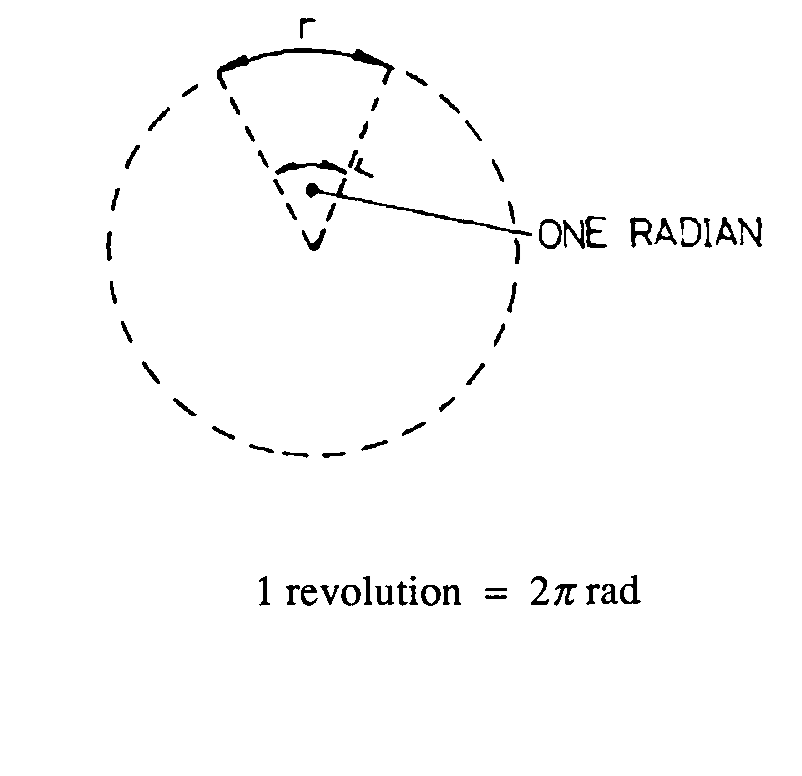
\(\textbf{Angular Velocity} (\omega)\): The rate of change of angular displacement. Mathematically: \[ \omega = \frac{\Delta \theta}{\Delta t} \] \[ \omega (rad/s) =2\pi n \:where\:n=speed\:in\:rev/s \]
\(\textbf{Angular Acceleration} (\alpha)\): The rate of change of angular velocity with respect to time: \[ \alpha = \frac{\Delta \omega}{\Delta t} \]
2.4 Equations of Angular Motion (Constant Angular Acceleration)
\[ \omega_2 = \omega_1 \mp \alpha t \]
\[ \theta = \frac{\omega_1+\omega_2}{2}t \]
\[ \theta = \omega_1 t \mp \frac{1}{2}\alpha t^2 \]
\[ \omega_2^2 = \omega_1^2 \mp 2\alpha \theta \]
where:
\(\omega_1\): Initial angular velocity (rad/s)
\(\omega_2\): Final angular velocity (rad/s)
\(\theta\) Angular displacement (rad)
\(\alpha\): Angular acceleration (rad/s2)
\(t\): Time (s)
Example 2.5 A shaft is rotating at 40 revolutions per minute (rev/min). It is uniformly decelerated at a rate of 0.017 rad/s² for 15 seconds. Calculate: 1. The angular velocity of the shaft at the end of 15 seconds (in rad/s and rev/min). 2. The total number of revolutions completed by the shaft during these 15 seconds.
import math

# Given

omega1_rpm = 40 # initial angular speed in rev/min
alpha = -0.017  # angular acceleration (rad/s^2), (-) for deceleration
t = 15          # time in seconds

# Convert initial speed to rad/s

omega1 = omega1_rpm * 2 * math.pi / 60

# Angular velocity after time t

omega2 = omega1 + alpha * t

# Angular displacement during time t

theta = omega1 * t + 0.5 * alpha * t**2

# Convert angular displacement to revolutions

revolutions = theta / (2 * math.pi)

# Convert omega2 to rpm

omega2_rpm = omega2 * 60 / (2 * math.pi)

print(f"Final angular velocity: {omega2:.4f} rad/s")
print(f"Final angular velocity: {omega2_rpm:.4f} rpm")
print(f"Angular displacement: {revolutions:.4f} revolutions")
2.5 Relation Between Linear and Angular Motion
The relationship between linear and angular motion is described by the following equations:
\(s = r \theta\) (linear displacement \(s\) and angular displacement \(\theta\)).
\(v = r \omega\) (linear velocity \(v\) and angular velocity \(\omega\)).
\(a = r \alpha\) (linear acceleration \(a\) and angular acceleration \(\alpha\)).
2.5.1 Variables
\(v\): Linear velocity, the rate of change of linear displacement \((v = \frac{ds}{dt})\).
\(a\): Linear acceleration, the rate of change of linear velocity \((a = \frac{dv}{dt})\).
\(s\): Linear displacement, the distance moved along the circular path.
\(r\): Radius of the circular path.
\(\omega\): Angular velocity, the rate of change of angular displacement \((\omega = \frac{d\theta}{dt})\).
\(\alpha\): Angular acceleration, the rate of change of angular velocity \((\alpha = \frac{d\omega}{dt})\).
\(\theta\): Angular displacement, the angle swept by the radius in radians.
2.6 Summary
Linear motion is directly proportional to angular motion, with the radius (\(r\)) acting as the proportionality constant.
Units for the variables:
\(v\): meters per second \((m/s)\),
\(a\): meters per second squared \((m/s^2)\),
\(s\): meters \((m)\),
\(r\): meters \((m)\),
\(\omega\): radians per second \((rad/s)\),
\(\alpha\): radians per second squared \((rad/s^2)\),
\(\theta\): radians (\(rad\)).